

SPIRITUALITY
VIEWED FROM A PHILOSOPHICAL PERSPECTIVE
What is spirituality? Is it a religion, a way of life, an inner experience or a search for the deeper nature of reality? Throughout history, the concept has been interpreted in many different ways. For some, spirituality is inseparably linked to religion, while others see it as a personal search for consciousness, interconnectedness and meaning.
Within The Fractal Framework, spirituality is not approached as a belief system, but as a field of philosophical inquiry. The central question is not what someone should believe, but how reality, consciousness and existence may be organized. In this sense, spirituality is neither an alternative to science nor to religion, but an additional way of exploring fundamental questions about existence.

Consciousness & Spiritual Experience
In many spiritual traditions, experiences of interconnectedness, unity, wonder and transcendence play a central role. The Fractal Framework recognizes these as authentic human experiences, without automatically drawing metaphysical conclusions from them.
The fact that a spiritual experience is associated with processes in the brain does not necessarily mean that its meaning can be fully reduced to those processes. At the same time, a spiritual experience in itself does not constitute proof of a supernatural reality. The Fractal Framework therefore deliberately adopts a philosophical middle position in which both scientific research and personal experience are taken seriously.
The Fractal Framework starts from the possibility of a potentially infinitely layered reality, in which organizing principles may repeat fractally across different scales and remain interconnected. From this perspective, spiritual experiences can be understood as emergent phenomena arising from the interaction between the organizational level of consciousness and the biological level of organization. Consciousness and biology are thus not regarded as separate realities, but as different levels of organization within the same ontological architecture.
Spirituality and Religion
Spirituality and religion are often confused with one another, but they are not the same. Religions generally offer a coherent system of beliefs, rituals, symbols and moral guidelines. Spirituality is broader. It can be experienced both within and outside religious traditions and focuses on the personal and philosophical search for consciousness, interconnectedness and meaning.
The Fractal Framework makes no claims about the truth or falsehood of religious beliefs. Nor does it present a new spiritual or religious system. Its focus is on the underlying question of why similar spiritual experiences and insights continue to occur across cultures and throughout history.
The Ontological Architecture of The Fractal Framework
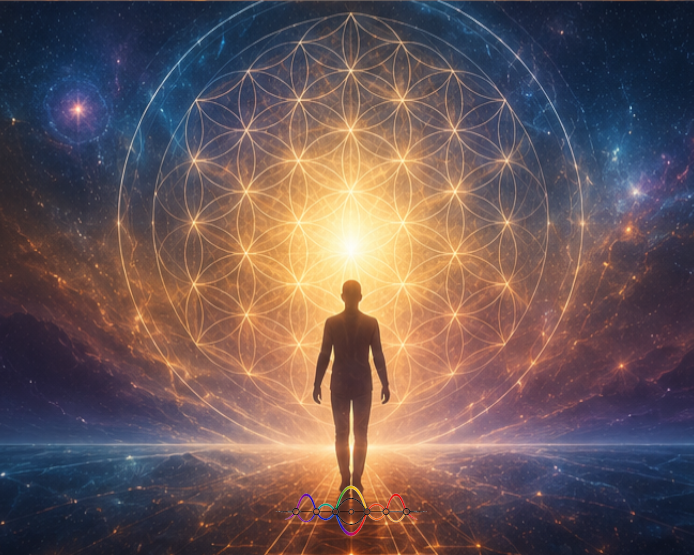
Within The Fractal Framework, reality is described as a potentially infinitely layered process of organization. Its ontological architecture consists of four inseparably interconnected pillars:
-
Information – the fundamental organization of reality.
-
Entanglement – the interconnectedness of processes and structures.
-
Emergence – the emergence of new properties and levels of organization.
-
Scale Relativity – the principle that properties and regularities may depend on the level of organization from which they are observed.
These four pillars do not constitute separate theories, but rather form a single, coherent ontological process. From this perspective, consciousness, life, society and spirituality can be explored as different manifestations of the same underlying principles of organization.
Within The Fractal Framework, these four pillars constitute the ontological architecture responsible for the organization of reality at all levels of organization: both those within the reach of our observation and description, and those that may lie beyond it. The principle of Scale Relativity also leaves open the philosophical possibility that this ontological architecture itself is an emergent manifestation of a comparable organizational process at a deeper or higher scale. This does not assert infinite regress as a fact, but rather leaves open an ontological possibility consistent with the fractal nature of the model.
The Fundamental Difference from Multidimensional Theories
Whereas multidimensional theories often assume separate dimensions, The Fractal Framework distinguishes itself by referring to levels of organization within a single reality. These levels emerge and develop from the same ontological architecture of Information, Entanglement, Emergence and Scale Relativity. They are therefore not fundamentally separate from one another, but remain part of a single, interconnected process of organization in which different levels of organization are interconnected and can mutually influence one another.
Invitation to Further Research
Spirituality may not begin with answers, but with wonder. With the willingness to ask fundamental questions about consciousness, reality and our place within the universe.
The Fractal Framework invites us to explore these questions from a new philosophical perspective. Not by placing science, religion or personal experience in opposition to one another, but by examining how they can complement each other within a single, coherent ontological framework.
An Open Process Philosophy
The Fractal Framework does not claim to be a Theory of Everything, nor does it offer definitive answers to the great questions of existence. It provides a philosophical interpretative framework in which science, philosophy and spirituality can complement one another without losing their respective methodological boundaries.
The strength of this approach lies not in offering absolute truths, but in developing a coherent perspective on the possible organization of reality. By deliberately allowing room for uncertainty, new insights and critical thinking, the model remains open to further development.
Maak jouw eigen website met JouwWeb