

PSYCHOLOGY
Is the Self a Fixed Entity or an Ongoing Emergent Process?
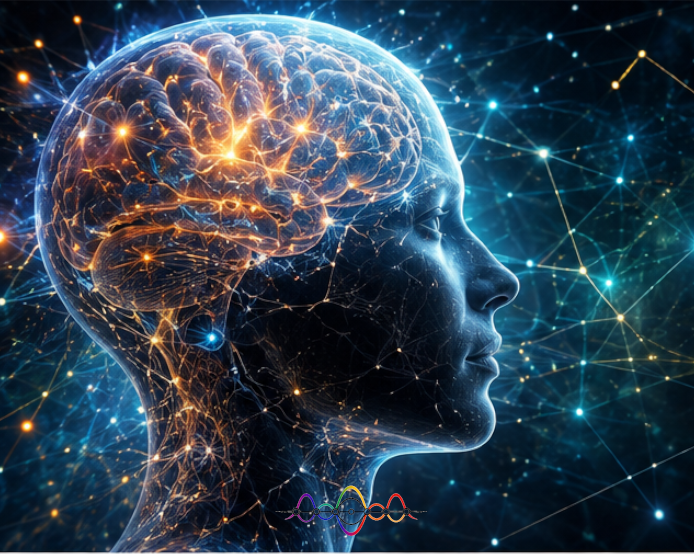
Psychology has undergone tremendous development over the past century. Modern psychological and neuroscientific insights have significantly deepened our understanding of behaviour, emotions, cognition and brain processes. At the same time, some of the most fundamental questions remain unanswered. What is consciousness? How does the experience of a coherent sense of Self emerge? Is identity a fixed property or an ongoing process of change? And how are our biological processes related to our subjective experience of reality?
A Philosophical and Ontological Interpretation within the Fractal Framework
The Fractal Framework explores these questions from a philosophical and ontological perspective. The insights of psychology and neuroscience are neither replaced nor corrected, but placed within a broader interpretative framework in which reality is understood as a potentially infinitely layered process of organization. The central question is not how psychological processes function in precise terms, but what these processes might be from an ontological perspective.
From this perspective, the human mind is not regarded as an isolated phenomenon. Consciousness, emotions, memories, thoughts and identity can be understood as emergent manifestations of an ongoing process of organization in which information is structured and develops across different levels of organization.
The human mind is therefore not a static entity, but a dynamic process that continues to reorganize itself throughout life under the influence of heredity, experiences, social interactions, culture and personal choices.
The Experience of the Self
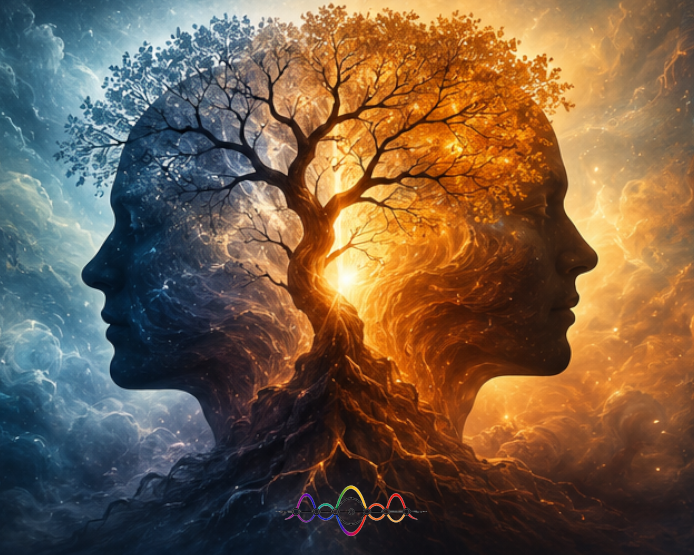
A central idea within The Fractal Framework is the philosophical possibility that the experience of the Self emerges from the interconnectedness of two emergent processes.
On the one hand, there is biological emergence, in which the brain, nervous system and body together form an extraordinarily complex information-processing organization. On the other hand, we can consider consciousness emergence, through which subjective experience, self-reflection and awareness manifest themselves.
From the perspective of The Fractal Framework, these two processes may be entangled. Rather than functioning as two separate realities, they can be understood as interconnected levels of organization that jointly give rise to a new reality: the experience of the Self. Within this interpretation, identity arises neither exclusively from biological activity nor exclusively from consciousness, but from the ongoing interaction between these two organizing processes.
As a result, the Self does not appear as an unchanging core, but as a dynamic information organization that continues to develop throughout life. Every new experience, memory, emotion and social interaction reorganizes this information and contributes to the ongoing development of identity.
Psychology within a Larger Reality
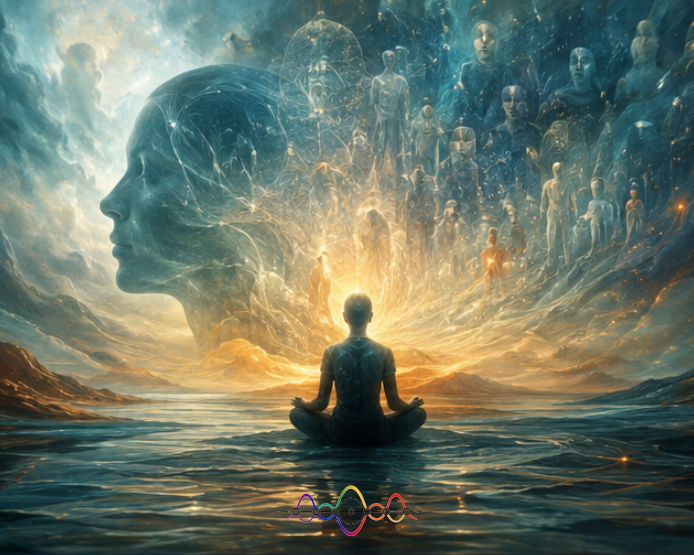
The Fractal Framework does not regard psychology as an isolated scientific discipline. The human mind is part of a broader ontological reality in which information, interconnectedness, emergence and scale relativity are continuously at work. From this perspective, psychology is not separate from biology, sociology or cosmology. Each discipline investigates a particular level of organization within the same underlying reality.
The processes observed within psychology can therefore be regarded as manifestations of the same fundamental ontological architecture that also underlies biological evolution, social organization and cosmological development. What changes from one scale to another are the forms of manifestation; what remains consistent are the organizing principles.
The Four Ontological Pillars
The Fractal Framework is based on four inseparably interconnected ontological pillars:
-
Information – every level of organization consists of organized information.
-
Entanglement – levels of organization are fundamentally interconnected and continuously influence one another.
-
Emergence – new properties and new realities emerge from the interaction of information.
-
Scale Relativity – the same organizing principles can manifest at different levels of organization without the phenomena being identical at every scale.
Together, these four pillars form a single ontological architecture that is not limited to psychology, but can be applied across a wide range of scientific disciplines.
Further Reading
This webpage provides an introduction to the main ideas presented in the paper. The complete philosophical foundation is developed in:
Psychology – A Philosophical and Ontological Interpretation within the Fractal Framework
Theory of Everything
Although The Fractal Framework appears to be coherently applicable across a wide range of disciplines, it does not claim to be the ultimate Theory of Everything. The model does not claim to provide definitive answers to all fundamental questions about reality or to replace existing scientific theories.
Instead, it offers a philosophical and ontological interpretative framework through which phenomena from different fields of knowledge can be approached using the same organizing principles. It is precisely this broad applicability that makes the model interesting. When a single interpretative framework can consistently offer new insights and connections across disciplines such as cosmology, consciousness, biology, psychology, economics, history and complexity, The Fractal Framework argues that it deserves serious philosophical and scientific consideration.
The value of the model therefore lies not in claiming to possess the ultimate truth, but in whether it can provide a fruitful framework for thought that opens up new perspectives and connects existing knowledge in a coherent way.
Maak jouw eigen website met JouwWeb