

fd-D3
fd-D3 (the second dimension) as a Potential Space of Organization
Within the Fractal Framework, fd-D3 (2nd dimension) occupies a special position. Not because it is claimed that reality is fundamentally two-dimensional, but because this space of organization offers opportunities to further investigate the relationship between Information, Entanglement, geometry and dimensionality. One of the questions that arises from this is whether an organization described within fd-D3 can manifest itself in a different way within fd-D4 (3rd dimension).
This opens up a line of inquiry that, at a conceptual level, may have points of contact with certain theoretical approaches exploring whether information at a lower-dimensional boundary can be related to a higher-dimensional description. This potential similarity is interesting, but an important distinction must be made. The Fractal Framework is not attempting to reformulate an existing holographic theory, nor does it claim that our three-dimensional reality is actually a projection of a two-dimensional reality.
The real question is what becomes possible when we investigate both dimensionalities as different forms of organization.

fd-D3 as a Potential Underlying Space of Organization
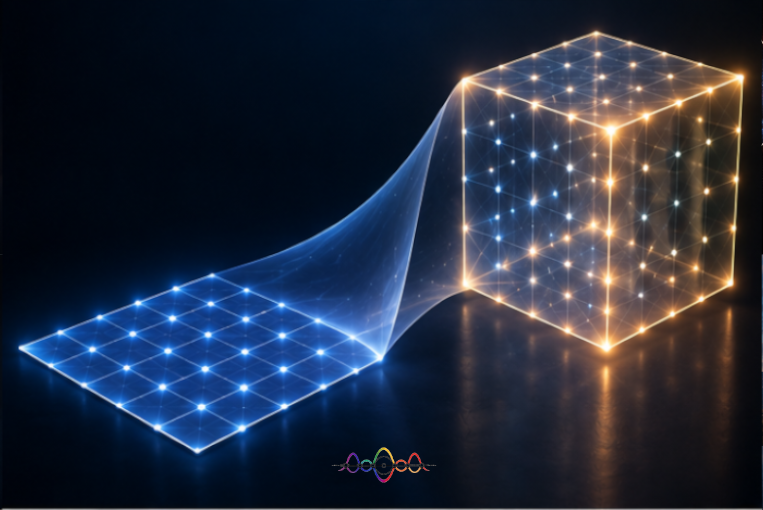
Within the Fractal Framework, fd-D3 (2nd dimension) is considered a potential geometric space of organization in which information and relationships can be investigated. Multiple fd-D1 units (0th dimension) can be mathematically represented as individual points within this space. When these points are subsequently connected through relationships, a geometric structure can emerge within fd-D3.
In this way, fd-D3 can be regarded as a space in which not only individual units of information, but also the relationships between those units, can be investigated. The interesting question arises when we ask whether such an organization necessarily has to remain within fd-D3.
Within the Fractal Framework, it can be explored whether a change in an information-entanglement organization within fd-D3 can have consequences that manifest at a different organizational layer. In that case, fd-D4 (3rd dimension) would not necessarily be the original space of organization, but rather a space in which the effects of an underlying organization become observable. This is explicitly a research hypothesis, not a conclusion.
The question, then, is not: “Is our 3D reality a projection of 2D?”
The question is:
“Can an organization within fd-D3, under certain conditions, manifest itself as an observable organization within fd-D4?”
That is a fundamentally different question.
Projection and Manifestation Are Not the Same
An important distinction within this exploration is the difference between projection and manifestation.
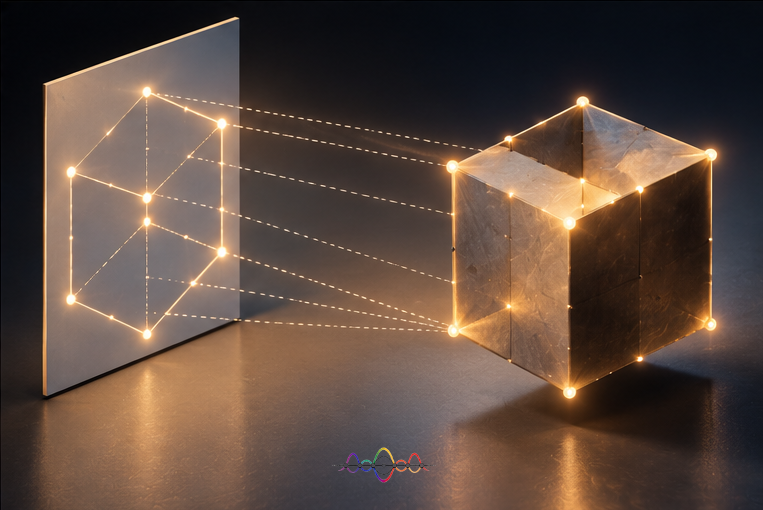
In a projection, a structure from one particular descriptive space is represented within another space. In doing so, information that is relevant to the original structure may not be fully visible in the projection.
A two-dimensional image of a three-dimensional cube, for example, is not itself a three-dimensional cube. The image represents certain properties of the cube, but does not necessarily contain all the geometric information of the original structure.
For this reason, the Fractal Framework approaches the term projection with caution.
When investigating whether an organization within fd-D3 can have consequences that become observable within fd-D4, this does not necessarily mean that fd-D4 is merely an image of fd-D3.
There may also be another form of relationship: a manifestation relationship.
This refers to the possibility that a change within a particular information-entanglement organization can express itself at another organizational layer without the original organization necessarily disappearing.
Within this line of thought, a change within fd-D3 can be considered a change of state. The original information organization does not necessarily have to disappear; the change may simultaneously manifest itself in a different way within fd-D4 (3rd dimension).
Whether such a relationship can be developed mathematically or physically is a separate research question.
Potential Connections with Holographic Approaches
The idea that information at a lower-dimensional boundary can be related to a higher-dimensional description has points of contact with certain holographic approaches in theoretical physics. This is precisely why it is interesting to consider this idea alongside the Fractal Framework. However, the similarity must be carefully defined.
The Fractal Framework does not claim that fd-D3 (2nd dimension) is the same as a holographic boundary in an existing physical theory. Nor does it claim that fd-D4 (3rd dimension) is therefore a holographic projection of fd-D3.
This is a conceptual comparison.
The question is whether the idea of a relationship between a lower-dimensional information organization and a higher-dimensional manifestation can give rise to a comparable line of inquiry within the Fractal Framework.
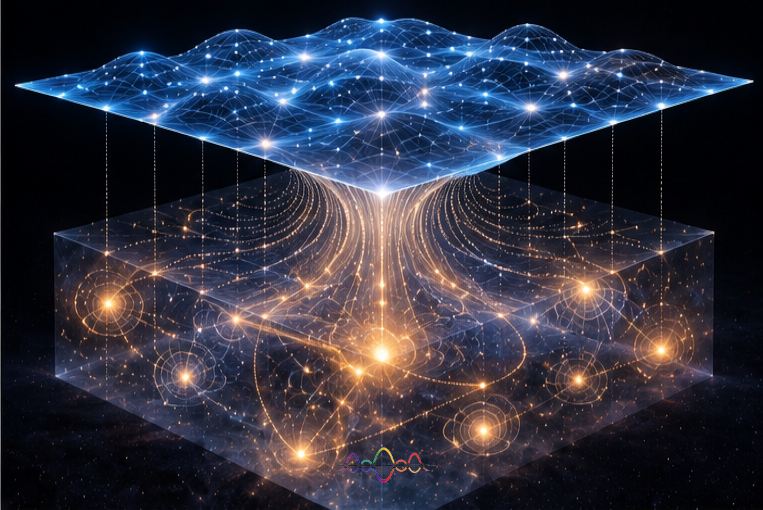
One possible starting point is the concept of excitation. In physics, particles, including electrons, are described within quantum field theory as excitations of an underlying field. Within the Fractal Framework, this raises a philosophical research question: can such an excitation be understood as a change within an underlying information-entanglement organization in fd-D3 (2nd dimension), the consequences of which manifest within fd-D4 (3rd dimension)?
In this interpretation, excitation does not necessarily mean a transition from one dimension to another. Rather, it can be investigated as a change of state within an underlying organization, resulting in an observable manifestation at another organizational layer.
This is explicitly not a claim that the electron field actually exists fundamentally within fd-D3. It is a possible line of inquiry:
Can a physical phenomenon that we conventionally describe within three-dimensional space be modelled in terms of an underlying two-dimensional information-entanglement organization?
An important distinction must be maintained between:
-
An existing physical theory
-
A philosophical-ontological interpretation
-
A possible hypothesis that still requires mathematical or empirical investigation
A conceptual similarity is, in itself, not evidence of an ontological or physical equivalence.
The Open Research Question
This line of thought gives rise to a further avenue of research within the Fractal Framework.
"Can a change in an information-entanglement organization within fd-D3 (2nd dimension) be modelled as a change of state in which the original organization within fd-D3 is preserved, while the consequences of that change manifest themselves as an observable physical organization within fd-D4 (3rd dimension)?"
If such a model could be constructed mathematically, a much more far-reaching question would then arise:
"Can a physical outcome that we normally describe in terms of conventional 3D space plus time be derived from a fundamental space of organization described within fd-D3 (2nd dimension)?"
This shifts the question of dimensionality.
Rather than asking only which dimension a phenomenon exists in, we also ask:
"Can the dimensionality in which we observe a phenomenon differ from the dimensionality in which its underlying organization is described?"
The Fractal Framework does not provide a predetermined answer to this question. It merely opens up the possibility of investigating the relationship between Information, Entanglement, dimensionality, geometry, Emergence and Scale Relativity from a different perspective.
A possible connection with holographic theories is therefore not a final conclusion, but a starting point for further investigation.
And this is precisely where the interesting boundary of this page lies: we can investigate the possibility without determining the outcome in advance.
For further exploration, read the paper:
Change Your Perspective
The Fractal Framework hopes that, after reading this page, you have become interested in the ontological philosophy it presents and find yourself wondering whether our way of perceiving reality is merely one perspective within a much greater whole.
Discover more about these ideas in the books and documents available for free download through the Fractal Framework. Prefer a brief introduction? Then explore our webpages, blogs and introductory articles, where the key concepts are explained in an accessible way.
Maak jouw eigen website met JouwWeb