
THE THINKER BEHIND THE WORDS
Get to know Dave Ruder and his philosophical framework. Discover how books such as The Fractal Framework, Layered Reality and Entanglement of the Self invite readers to explore consciousness, reality and the patterns that continue to recur across different scales of existence with an open and enquiring mind.

WHO IS DAVE RUDER?
Dave Ruder is an independent thinker, born and based in the Netherlands. Driven by a lifelong fascination with consciousness, reality, philosophy, science, spirituality and the underlying organisational patterns of nature, humanity and the cosmos, he developed his own philosophical framework.
In his books, he explores the possibility that reality unfolds across interconnected scales, within which similar organising principles continue to repeat in a fractal manner. At the intersection of science, philosophy and spirituality, he invites readers to reflect on consciousness, identity and our place within an infinite whole of layered realities, with an open and enquiring mind.
Dave Ruder is the architect of the Fractal Framework, an original ontological model exploring the fundamental architecture of reality.
Developed in 2025, the Fractal Framework is built upon four interconnected pillars: Information, Entanglement, Emergence and Scale Relativity. The model seeks to explain how reality emerges, organizes and evolves across different scales and domains of existence.
An interesting numerical aspect of his surname is its correspondence with two gematria systems. According to the applied Hebrew gematria calculation, Ruder has a numerical value of 369, while in English gematria its value is 396.
These numerical correspondences form an additional point of personal interest within his broader exploration of patterns, relationships and the possible significance of numerical structures.
Dave Ruder continues to develop and expand the Fractal Framework through books, theoretical documents and interdisciplinary research papers, making his work freely accessible to an international audience.
HIS APPROACH TO REALITY
Dave Ruder has a broad interest in consciousness, reality, spirituality, religion, philosophy and the underlying patterns that become apparent in nature, humanity and the cosmos. Driven by a constant curiosity about the nature of existence, he explores questions at the intersection of science, philosophy and spirituality.
His work is not primarily concerned with providing definitive answers, but with exploring new perspectives. His approach is characterised by a search for recurring patterns, interconnectedness and the possibility that reality consists of multiple layers that influence and give rise to one another.
In his earlier book, Entanglement of the Self, he explores how identity, consciousness and the sense of being a separate self may arise from relational processes.
In his first book, The Fractal Framework, he laid the foundations for his philosophy of Scale Relativity, exploring how the same underlying patterns can manifest themselves across different scales of reality.
With Layered Reality, he brings these ideas together in an exploration of the origins of consciousness, space, time and existence. It is an invitation to look beyond what we take for granted and to approach the reality in which we live with a renewed sense of wonder.
THE FORMATIVE FORCE
"My life has included both great highs and profound lows. For a period, I lived without a permanent home, experienced PTSD, had to say goodbye to a child and lost my partner, who made the conscious decision to end her life through euthanasia. In addition, a near-death experience profoundly changed my perspective on consciousness and reality.
These experiences not only raised many questions, but also set me on a lifelong quest to understand the nature of existence. They became the foundation for my philosophical framework and the books The Fractal Framework, Layered Reality and Entanglement of the Self. In these works, I explore how science, philosophy, spirituality and personal experience can complement one another in the search for a deeper understanding of reality, consciousness and our place within the greater whole.
My books are not a collection of answers, but an invitation to approach reality with an open and enquiring mind, and to question established assumptions."
Dave Ruder
"Keep Asking Questions About Who We Are and What Reality Is."
Dave Ruder,
the Fractal Framework
A LITTLE MORE DETAIL
Dave Ruder describes his philosophical framework in books that explore the boundaries between philosophy, science and consciousness. His work focuses on how complex systems in nature and the human mind are interconnected.
-
The Fractal Framework: In this book, he explores a reality in which everything, from the smallest particles to human consciousness, is structured according to fractal patterns: patterns that continue to repeat across different scales. The book introduces the principle of Scale Relativity and offers a new way of looking at reality, consciousness and the cosmos.
-
Layered Reality: This book develops the principle of Scale Relativity further. The author explores the possibility that reality consists of an infinite whole of interconnected scales, each with its own perspective and laws. What we experience as absolute is therefore dependent on the scale from which we observe. The book invites readers to look beyond fixed definitions and approach reality as a dynamic, layered process.
-
Entanglement of the Self: In this book, he applies the same philosophical framework to consciousness and identity. It explores how the I arises from biological, cultural and social patterns, while the Self — the observing consciousness, the I Am — can observe these patterns without identifying with them. The book thereby offers a deeper philosophical exploration of the relationship between the individual, consciousness and the greater whole.
Together, his books form a philosophical framework through which he seeks to uncover the “hidden order” of reality. In doing so, he combines mathematical concepts such as fractals with profound questions about life and who we are.
KEY THEMES
1. The Fractal Framework: The World as a Pattern
The central idea of this book is that reality does not consist of separate “things”, but of recurring patterns.
-
Structure at Every Scale: Ruder argues that the same principles we observe in nature, such as the branching of a tree or the shape of a coastline, also recur in our thoughts and social structures.
-
A Non-Linear Reality: He proposes that we should no longer view the world as a straight line of cause and effect, but as a complex web of fractal interactions in which everything influences everything else.
-
Four Parts: The book guides readers step by step from physical matter to abstract human thought, ultimately leading to a new perspective on our surroundings.
2. Entanglement of the Self: The Connectedness of Consciousness
This work explores quantum philosophy and the role of the observer in greater depth.
Entanglement: Ruder uses this term to illustrate that the “I” is not an island. He argues that our consciousness is inseparably connected to our environment and to other people.
-
Identity: The book challenges readers to let go of the ego and see themselves as part of a larger, entangled system.
-
Self-Reflection: Whereas The Fractal Framework focuses more on the external structure of the world, Entanglement of the Self is a more introspective journey into the nature of our own consciousness.
3. Layered Reality: Reality as a Scale-Relative Process
This book provides a deeper philosophical exploration of The Fractal Framework and examines how reality may unfold across interconnected scales.
-
Scale Relativity: In this book, Ruder proposes that what we experience as reality depends on the scale from which we observe. Each scale has its own laws, while simultaneously forming part of a greater whole. The book explores the possibility that reality does not consist of a single absolute layer, but of an infinite whole of interconnected scales. What appears to be a boundary at one scale may, from another scale, be part of a larger process.
-
Perspective: Whereas The Fractal Framework introduces the foundations of the philosophical model and Entanglement of the Self applies it to consciousness and identity, Layered Reality focuses on the structure of reality itself. It shows how our perception, knowledge and experience of truth are limited by the scale at which we exist.
4. A Shared Purpose: A New Perspective
The ultimate aim of his work is to give readers a “new pair of glasses” through which to view reality. He seeks to show that science — including mathematics and quantum mechanics — and spirituality — including connectedness and consciousness — are not mutually exclusive, but can complement one another within a comprehensive worldview.
His books appeal to readers who enjoy thinking outside the box and are willing to question their own assumptions about reality.
Mathematical principles are not presented merely as abstract calculations, but as a conceptual framework for understanding the structure of the universe and the human mind.
THE MAIN MATHEMATICAL APPLICATIONS IN HIS WORK
1. Fractal Geometry and Self-Similarity
In The Fractal Framework, he applies the principle of self-similarity. This is the mathematical concept that patterns repeat across different scales.
-
Macro versus Micro: He draws parallels between the structure of galaxies (macro) and the functioning of the human brain or atoms (micro).
-
Consciousness as a Fractal: He proposes that our thinking is not linear, but structured according to fractal patterns. Just as a branch resembles the tree as a whole, our smallest thoughts, in his view, reflect the larger structure of our personality.
2. Quantum Entanglement
In Entanglement of the Self, he applies principles from quantum mechanics to the philosophy of identity.
-
Non-Locality: Mathematically, two particles can be entangled regardless of the distance between them. He uses this concept to argue that the human “I” is not an isolated unit, but is mathematically connected to the rest of reality.
-
The Observer Effect: He applies the idea that an observer influences the outcome of an experiment, as described in quantum physics, to explain how our consciousness shapes our physical reality.
3. Systems Thinking and Algorithms
Ruder views nature as a system that “runs” on mathematical algorithms. He applies this logic by proposing that:
-
Determinism and Chaos: Although the world may appear chaotic, underlying mathematical laws govern how systems develop. The Mandelbrot set is an example of such mathematical structure.
-
The Golden Ratio: He refers to universal proportions, such as the Fibonacci sequence, to support the idea of aesthetics and balance in both nature and the human mind.
His work is described as a bridge between hard mathematics and soft philosophy, through which he seeks to demonstrate that spirituality is essentially a form of “higher mathematics and physics” that we do not yet fully understand.
Within the context of his work, fractal dimension is more than just a number; it is a measure of the complexity and layered nature of reality.
WHAT IS FRACTAL DIMENSION?
In classical Euclidean mathematics, we work with whole numbers: a line is 1D, a plane is 2D and a cube is 3D. A fractal dimension, often referred to as the Hausdorff dimension, can, however, be a fractional number, such as 1.2 or 2.6.
This number indicates how much of the available space a pattern occupies:
-
An irregular coastline is more than a line (1D), but does not completely fill a plane (2D). Its dimension therefore lies somewhere between the two.
-
In Ruder's philosophy, this symbolises the density of information. The higher the fractal dimension of a system, such as the brain or a social network, the more complex its connections are.
HOW DOES RUDER APPLY THIS TO HUMANITY?
He extends this mathematical logic to our consciousness and identity:
-
The Dimension of the ‘I’: He suggests that our consciousness is not a fixed point, but a fractal structure with its own dimension. Through our interactions and thoughts, we “fill” the space around us.
-
Complexity as a Means of Survival: In nature, systems with a particular fractal dimension, such as lungs or blood vessels, are highly efficient at exchanging energy and information. He applies this principle to human behaviour, proposing that successful systems of thought follow these mathematical “ideal” proportions.
-
Infinity in the Limit: Since a fractal continues infinitely in mathematical terms as we zoom in, he uses fractal dimension to illustrate the idea that there is infinite depth within the human being. We are not limited to our physical body (3D), but are part of a multidimensional network.
Within his philosophical framework, free will is not a choice between ‘A’ or ‘B’, but the capacity to navigate the infinite depth of one's own fractal structure.
HOW DOES HE CONNECT FRACTAL MATHEMATICS TO HUMAN FREEDOM?
1. The Paradox of Determinism and Freedom
A fractal, such as the Mandelbrot set, is generated by a simple, fixed mathematical formula (determinism). Yet the resulting structure is so complex and infinitely detailed that its outcome is unpredictable.
-
Application: Ruder argues that although we are bound by biological and physical laws (the “formula”), the space within those laws is infinitely vast. We are free because, within the boundaries of our existence, we can continually discover new layers of depth.
2. Free Will as ‘Zooming In’
In a fractal, you determine where you look by choosing where to zoom in.
-
The Choice: According to Ruder, you exercise free will by directing your attention. Although the patterns are fixed, you choose which details to focus on and which layer of reality to explore. Your “choice” is therefore essentially the determination of your own perspective within an already existing, infinite system.
3. Breaking Away from Linear Time
Free will is often viewed as a choice made in time: what will I do next? Ruder extends this idea into the dimension:
-
He suggests that we do not merely move horizontally through time, but also vertically through the fractal layers of our consciousness.
-
The more aware you become of the fractal nature of your own Framework, the more “dimensions” you have available in which to act. Freedom therefore grows as you gain greater insight into the patterns of which you are composed.
4. Feedback Loops
Mathematically, fractals arise through iteration: the result of the previous calculation becomes the input for the next.
-
Self-Direction: Ruder sees this as the mechanism of free will. By reflecting on our own actions (the input), we change the outcome of the next step. In this sense, we become the programmers of our own recurring patterns.
His conclusion is essentially that we are “free within a form”. We cannot change the laws of the fractal, but we are free to shape the infinite variations within them.
THE THINKER BEHIND THE FRAMEWORK
Dave Ruder describes himself as a “hobby thinker”.
Despite the depth and scientific and philosophical foundations of books such as The Fractal Framework, he is an author without formal scientific training. The term “hobby thinker” fits his approach to the subjects he explores:
-
No Academic Pretensions: By describing himself as a hobby thinker, he indicates that his work stems from personal wonder and a lifelong search for understanding, rather than from a strictly academic or professional philosophical background.
-
Freedom of Thought: The term hobby thinker also suggests a certain freedom. He is not bound by the rules of a specific scientific discipline, allowing him to draw connections more freely between mathematics, biology and spirituality.
-
Accessibility: It makes his otherwise complex ideas about fractals and quantum mechanics more accessible to a wider audience. He invites readers to explore and piece together the nature of reality alongside him.
THE ARTISTIC SIDE OF DAVE RUDER
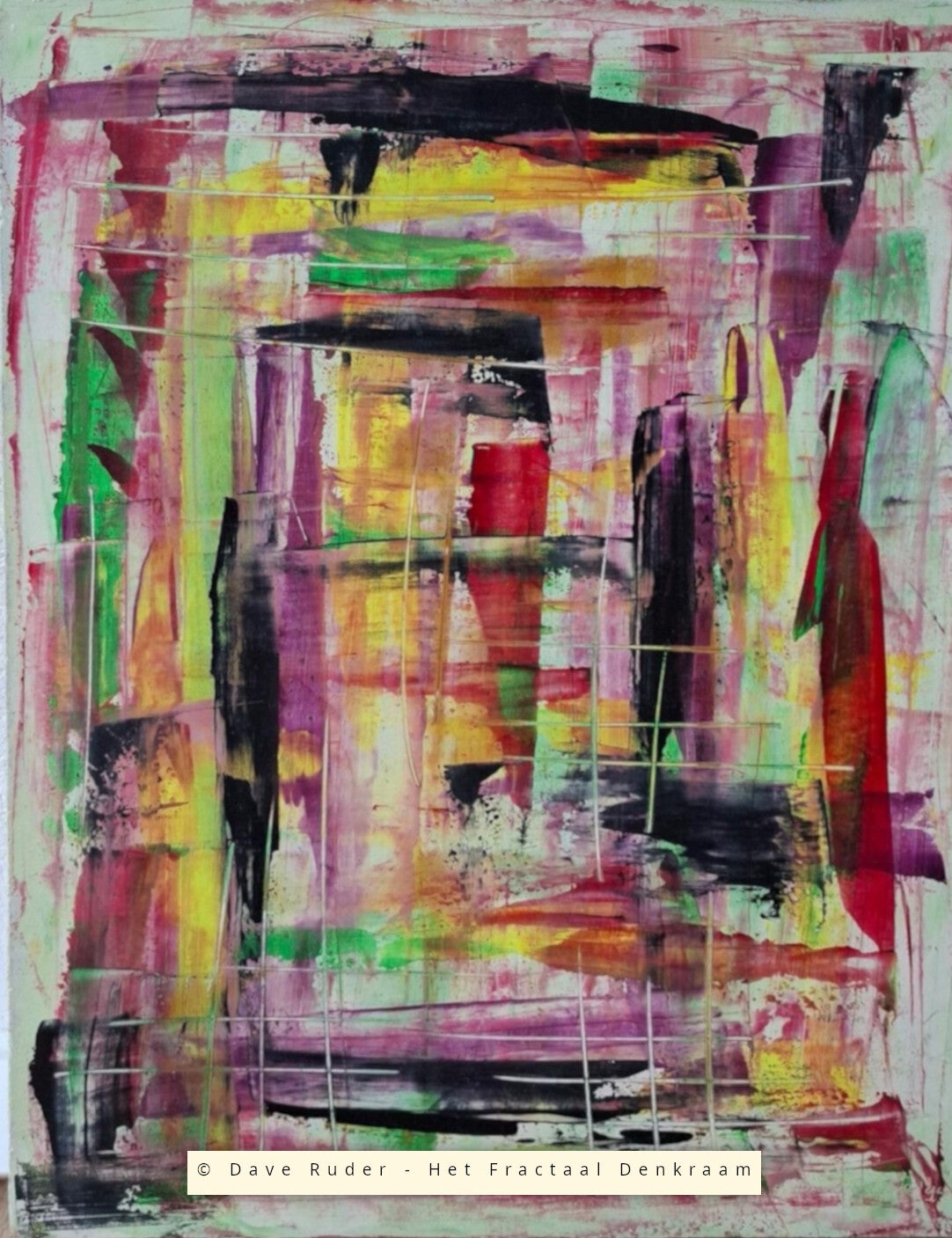
The artistic side of Dave Ruder is expressed not only through words, but also through paintings. These paintings often provide a visual interpretation of themes found in his books. Most of his paintings were created during the 1990s.
His artworks are characterised by:
-
Fractal Compositions: In keeping with his book The Fractal Framework, he uses patterns that repeat and interweave. He seeks to capture on canvas the “hidden order” he perceives in nature and consciousness.
-
Graphic Influences: His many years of experience in the graphic arts industry are reflected in the often clean, structured composition of his paintings. His craftsmanship is evident in the use of lines, grids and geometric shapes.
-
The Connection Between Art and Philosophy: The complex subject matter of quantum philosophy and the entanglement of the “I” was already finding expression in Dave Ruder's paintings decades before his books, even though he was not yet consciously aware of the complexity of these subjects.
His paintings effectively function as preliminary “illustrations” of his philosophical framework. They made abstract ideas about dimensions and infinity visible long before these ideas found expression in his books, published decades later.
Maak jouw eigen website met JouwWeb