
Geometry
Geometry as a Way of Making Organization Visible
Geometry is one of the oldest ways in which humanity has attempted to describe forms, proportions and spatial relationships. A point, a line, a plane and a volume can be used to describe increasingly complex geometric structures.
Within the Fractal Framework, geometry is not regarded as a direct representation of reality. A geometric form is a representation through which certain properties of organization can be made visible and open to discussion. This distinction is important. A geometric description can tell us something about how a structure is organized, without the geometric representation itself being equated with the reality it describes.
A cube, for example, can be used as a geometric representation of certain properties of fd-D4 (= 3rd dimension, conventional 3D). However, our fd-D4 space is not itself a cube. The cube is a model that allows us to represent certain relationships, measurements and spatial properties.
From this perspective, an important question arises within the Fractal Framework:
What can geometry tell us about the organization of reality when we do not equate geometric representation with reality itself?
Geometric Information and Organization
A geometric form consists of more than just its outward appearance. Geometric descriptions also contain relationships.
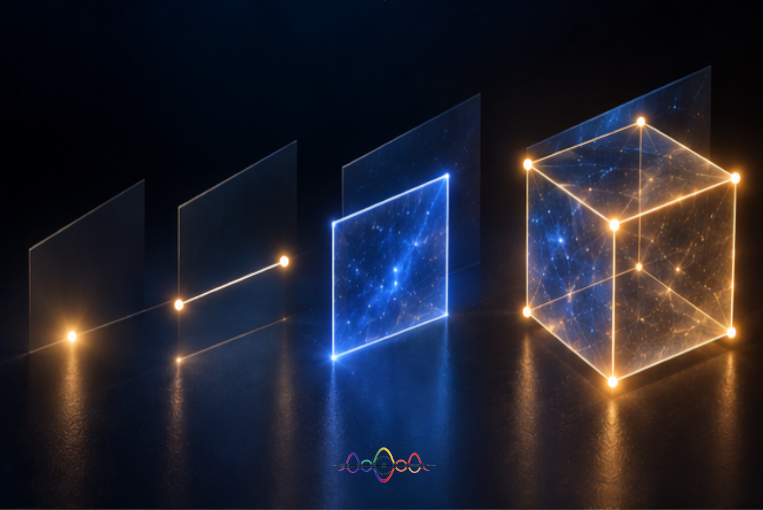
A point can represent a distinction. Multiple points can be positioned relative to one another. By describing relationships between points, lines, planes and more complex structures can emerge. Geometry thereby makes certain forms of relational organization visible.
Within the Fractal Framework, this can be connected to the pillars of Information and Entanglement.
Information makes distinction possible. Within the Fractal Framework, Entanglement describes the relational connectedness between units of information. When such relationships are represented geometrically, recognizable structures can emerge. Geometry can therefore be explored as a possible manifestation of relational information organization.
This does not mean that every geometric form can necessarily be derived from the four pillars. Rather, geometry offers an interesting descriptive layer through which to investigate how distinction, relationship and organization may relate to one another.
Complex patterns can also be represented within a geometric space. In addition to regular geometric structures, quasi-geometric, fractal and chaotic patterns can, for example, be made visible. Geometry therefore does not have to stand in opposition to fractality. A geometrically organized space can simultaneously contain structures that exhibit fractal characteristics across different scales.
Geometry & Emergence
Geometry can also make visible how more complex structures can be constructed from simpler geometric elements.
A point can be connected to other points to form a line. Lines can together define a plane. Planes can subsequently define a spatial structure. A cube, for example, can be geometrically constructed from points, lines and planes.
In a similar way, higher-dimensional geometric structures can be mathematically constructed from lower-dimensional elements. A tesseract, for example, can be described in terms of multiple cubic cells. This geometric construction is interesting within the Fractal Framework because it can provide a visual representation of emergence.
However, an important distinction must be made. Geometry shows how a structure can be constructed within a geometric model. This does not establish that ontological reality itself originates in the same way.
Geometry therefore does not show how reality necessarily exists. It can, however, make visible how different forms of organization may relate to one another. In this way, geometry can become a tool for formulating questions about Emergence.
The question is therefore no longer simply: "What does a structure look like?" We can also ask: "What kind of organization is required for this structure to emerge within the model?"
Geometry Is Not Reality
The distinction between representation and reality ultimately forms an important starting point within The Fractal Framework.
A map is not the landscape. A formula is not the phenomenon it describes. And a geometric shape is not automatically the reality it represents. Geometry provides us with a way to abstract, compare and make visible certain properties of organization.
For this very reason, geometry can also have limitations. A representation reveals certain properties, while other properties may remain hidden. A two-dimensional image of a three-dimensional structure, for example, may contain information about shape and proportions, while other spatial relationships are not directly visible. This creates a distinction between the dimensionality of a representation and the possible dimensionality of what is being represented.
Within The Fractal Framework, the question is therefore whether geometry can be more than merely a descriptive mathematical language. Perhaps geometry can help us compare different forms of organization and raise new ontological questions. But geometry itself does not determine the answer. The geometric representation is not reality. It is a way of looking at reality.
From this perspective, geometry can be regarded as a language of inquiry and a model. It gives us the means to make distinctions, proportions, relationships, structures, dimensionality and possible emergence visible.
Within the Fractal Framework, geometry is therefore neither a starting point nor an endpoint. It is a window onto possible forms of organization.
Geometry shows us what we can describe. The Fractal Framework then asks what that description can teach us about the underlying organization.
Sacred Geometry and the Flower of Life
Alongside the formal and mathematical approach to geometry, there is a long-standing tradition in which certain geometric shapes have acquired a special or symbolic meaning. These forms are often grouped under the term sacred geometry.
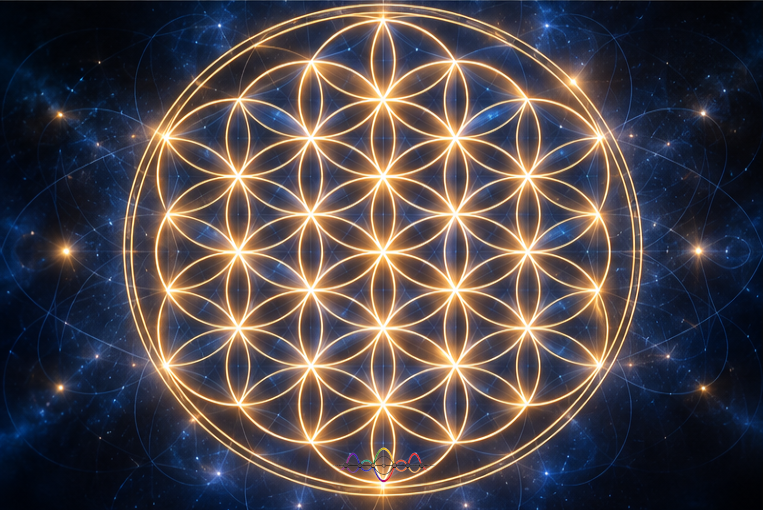
A well-known example is the Flower of Life, a pattern created by arranging circles of equal radius so that they overlap in a regular manner. Through the repetition and mutual proportions of these circles, a complex geometric pattern emerges in which symmetry, proportion and repetition become visible.
Various esoteric and spiritual traditions have attributed deeper meaning to such geometric patterns. It is important, however, to distinguish between the historical development of this symbolism and the interpretations assigned to it in later spiritual traditions. In this context, The Fractal Framework makes no claims about an original or universal meaning of the Flower of Life.
The geometric structure itself, however, is interesting from the perspective of The Fractal Framework.
The individual circles can be considered geometric representations of distinct information structures. Where circles touch and overlap, relationships emerge. Through the repetition of these relationships, a larger geometric organization takes shape.
In this way, the Flower of Life can be used as a visual representation of relational organization.
Not because the Flower of Life proves that reality is organized according to The Fractal Framework, but because the pattern makes visible how simple geometric elements can form a more complex structure through repetition and mutual relationships.
This is precisely where an interesting connection with the four pillars of The Fractal Framework emerges. Information can be represented as distinguishable elements, Entanglement as the relationships between these elements, and Emergence as the formation of a new, more complex organization from these relationships. When the same organization becomes recognizable again at another scale, the question of Scale Relativity can subsequently be raised.
The Flower of Life does not need to be regarded as an image of reality. Within The Fractal Framework, it can instead be considered a geometric model through which certain forms of organization can be made visible.
This brings us back to the central idea of this page: geometry is not reality itself.
The value of a geometric pattern does not necessarily lie in whether it contains a hidden image of reality, but also in what forms of organization it enables us to investigate.
From this perspective, sacred geometry can also be reconsidered: not as proof of an underlying cosmic order, but as a collection of human geometric models that can give rise to questions about symmetry, proportion, repetition, relationships, organization and scale.
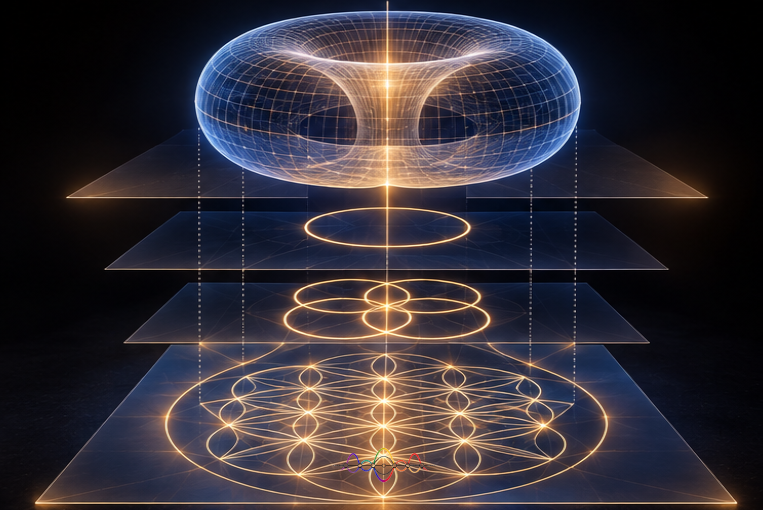
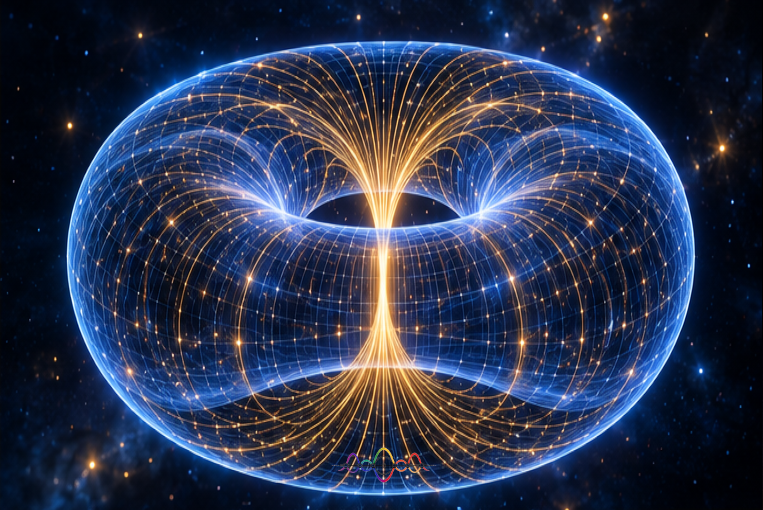
An interesting research question is whether geometric patterns such as the Flower of Life can be understood as two-dimensional representations of underlying three-dimensional structures, such as a toroidal organization. In that case, the circles and their mutual proportions might reflect certain properties of the underlying structure in the projection. This does not mean that the Flower of Life actually represents a toroidal structure, but rather that it is worth investigating whether certain geometric similarities could arise from such a projection.
The Flower of Life therefore represents an interesting intersection between geometry, symbolism and ontological interpretation. Within The Fractal Framework, it is primarily this final step that matters:
"What can geometric patterns teach us about possible forms of organization, without confusing the representation with reality itself?"
Change Your Perspective
The Fractal Framework hopes that, after reading this page, you have become interested in the ontological philosophy it presents and find yourself wondering whether our way of perceiving reality is merely one perspective within a much larger whole.
Explore these ideas further through the books and documents available for free download within The Fractal Framework. Prefer a brief introduction? Then take a look at our webpages, blogs and introductory articles, where the key concepts are explained in an accessible way.
Maak jouw eigen website met JouwWeb